Journal Entry #1
Shōreisai festival at Mount Haguro (2025)
This year, I went to see the Shōreisai festival at Mount Haguro, in Yamagata prefecture. It was a trip intended as a fieldwork for my PhD dissertation, but half of it was also to spend the New Year with my wife.
I shall start by explaining how we got to Mount Haguro from Sendai. Yamagata is a prefecture in the region of Tōhoku, well known for its heavy snows during winter. Accessing Mount Haguro at this time of the year isn’t easy. Although our car was already equipped with winter tires, both of us didn’t have experience driving in the snow, so we had decided to go to Tsuruoka city by highway bus, and then ride a local bus to the top of Mount Haguro the 30th of December. But I had to learn the hard way that things won’t go so smoothly. It is one of the busiest times of the year in Japan. We already had trouble with the reservations of our lodging, just being able to have a night for the 30th (fortunately later we managed to talk to the owner once we were there and he somehow made room for us for the 31th as well.). Bus reservations from Sendai to Tsuruoka were full. Learning this the same morning we had planned to depart, we decided to get on the car and ride all the way to Mount Haguro. The highway to Yamagata was snowy and it was raining, but we somehow managed to arrive safely. It was around a 3 hour ride. First, when we arrived at Tōge, we had lunch, and then drove up to the summit of Mount Haguro, where we parked the car during all of our stay.
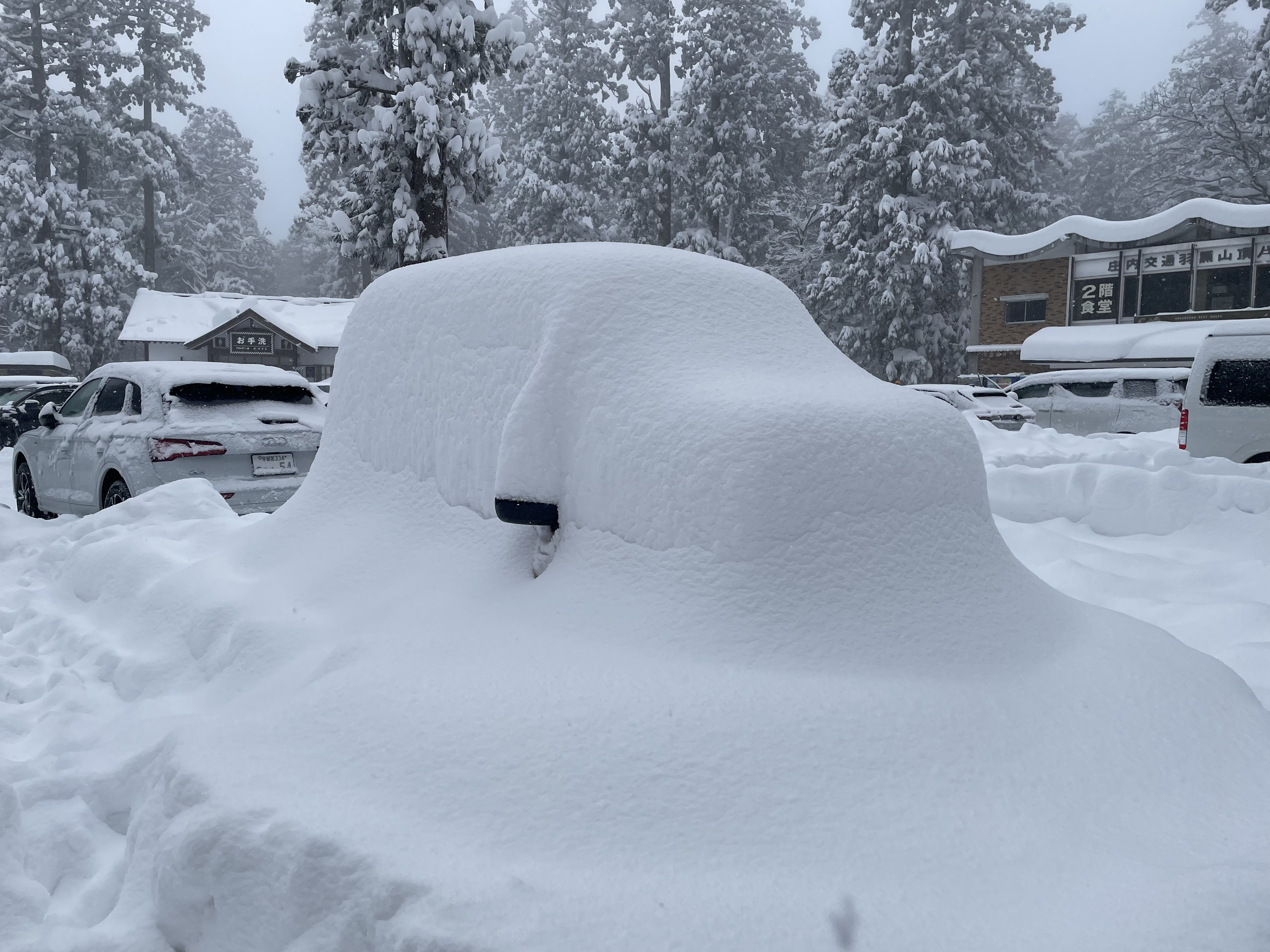
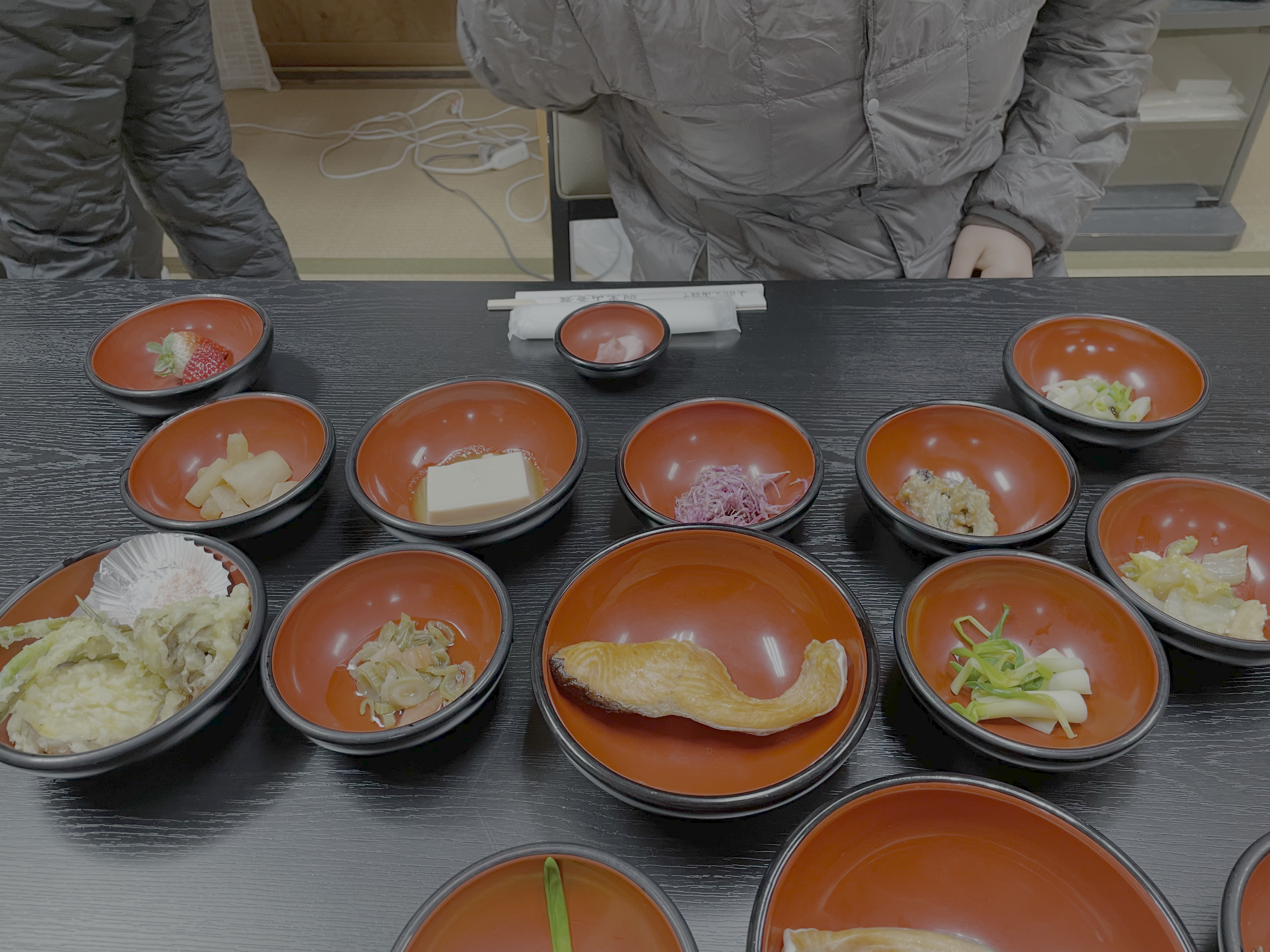
The first day we spent it chilling. We had a stroll around Dewa Sanzan Shrine and were surprised by how snowy it was. Then we went to our lodge, the Saikan. It’s a lodge connected to the shrine which used to be a temple before the Meiji Restoration (1868). We feared it would be cold, but fortunately the room had a stove and a warm futon, with other amenities. For dinner, they served us with shōjin ryōri, a type of food mostly consisting on sansai, vegetables harvested in the mountain. It is said that this is the type of food that yamabushi eat to purify themselves before entering the mountains. There is no meat, but they do serve fish sometimes in it (I am guessing this is also something that changed after the Meiji Restoration, since in Buddhism eating meat or fish was not allowed). After that, we had a nice warm bath and went to sleep early, since breakfast was scheduled to be at 7 a.m.
Next morning I spoke to the owner and we managed to secure one more night at the Saikan. Had I not been able to do this, we would have had to spend the night in the car, which would have been devastating given how cold it was and how unprepared we were. The 31th was a busy day, full of different festivals and events going on from 9.00 a.m to 3.00 a.m next day.
During breakfast, I we met some other people who had come to see the festivals at Mount Haguro. One of them was Adrian, who was the photographer who had taken the picture for Shayne’s new book, which I have been requested to write a book review for. It’s a small world! Adrian was very nice, we exchanged contacts and kept in touch for the events going on at Mount Haguro during that day. He seemed interested in my research, and asked me many questions about the history of Shugendō at Mount Haguro during the Meiji period. I also was surprised by his relation to Shugendō. He came as a professional photographer, and he is looking forward to publish a book with a collection of his best pictures on the topic on the near future. But Adrian is not only a photographer, he also works as a Yoga instructor in Kobe. He recounted how he studied and experienced mikkyō, and how it had influenced his life and changed his philosophy. Surprisingly, he seemed to be kind of dissapointed with Shugendō. Although he had also experienced it, he told me how it didn't make him feel anything new. For him, Shugendō didn't appear profound enough, and he had no sensation of "authenticity". He also asked about the most "authentic" form of Shugendō at Mount Haguro. As an aspiring historian of religion, I gave him the best answer I could, explaining how the Shugendō he sees today came to be after Meiji Restoration. I did recommend him to try accesing the practice through Shōzen'in Temple, there he would probably find something closer to what he was looking for. However, I also advised him that accesing training at this temple would not be an easy task, given how reclusive they seem to be in recent years towards the acceptance of new practitioners.
| Time | Content | Place |
|---|---|---|
| 8:30 | Ōtaimatsu maruki 大松明まるき | Yard |
| 13:00 | Matsu no fuda - Sakaki no kuyō 松の札・榊の供養 | Yard |
| 15:00 | Tsuna Maki 綱まき Oyadama onigiri furumai 親玉おにぎり振る舞い Ōharaishiki 大祓式 |
Yard Yard Main Shrine |
| 16:00 | Joyasai 徐夜祭 | Main Shrine |
| 17:00 | Shinpai 神拝 | Cottage |
| 18:00 | Shōreisai Hondensai 松例祭本殿祭 Hachiko Jinjasai 蜂子神社祭 |
Main Shrine Hachiko Shrine |
| 18:30 | Ōtaimatsu marukinaosh 大松明まるき直し | Yard |
| 20:30 | Suna hakiwatashi izaizake 砂はき渡し祝酒 | In front of the cottage |
| Around 21:30 | Deyaku 出役, Goteime 御掟目 | First, in the cottage of the ijō 位上, then in the cottage of the sendo 先途 |
| 22:45 | Gengurabe 験競べ | Main Shrine |
| 23:00 | Goban hora to dōji ni ōtaimstsubiki 五番法螺と同時に大松明引き | Yard |
| 00:00 | Kuniwake shinji - hi no uchikae shinji 国分け神事・火の打替神事 Shōjinsai 昇神祭 |
Yard Cottage |
| 3:00 | Saitansai 歳旦祭 | Main Shrine |
During the morning, we went around the Main Hall of Dewa Sanzan Shrine and the surrounding area. We checked the places where the events would take place, but after realizing that there wasn’t so much going on during the morning, we went back to the lodge to rest. After that, we went to a nearby shop to have lunch.
At around 13:00 the events began. We saw the two matsu hijiri coming accompanied by other yamabushi. These two matsuhijiri were the protagonists in many of the events that day. Every year, they are chosen by the local yamabushi to take the role during this festival. I should mention that they actually have been performing different rituals for two months up until the 31th, and it is during the last month of their ritual that they go up Mount Haguro and spent every day away from their families, chanting prayers for the mountains of Dewa and performing other religious activities. It could be said then that the 31th is the culmination of their long ascetic practices. During the many events as the festival, these matsuhijiri lead two teams, which engage in the different rituals in which they usually compete. The competition between the two in these many rituals serve as an divination for knowing if next year’s harvest will be bountiful, or on the other hand the fishermen will have prosperity in their activities, depending on which matsuhijiri wins. For most of the day, both matsuhijiri and their teams spend the time in a cottage, were they constantly recite prayers for the mountains, do prayers for those who go to them, and speak to the people. The prayers they recite are these two:
Moromoro no tsumi kegare wo harai misogite sugasugashii
"Cleanse all impurities. Purify all sins. Exorcise and rejuvenate."
Tōtsu kami emi tama he mizu no mitama wo saki hae tama he
"May the distant kami smile upon and bless honorable spirits with good fortune."
Amatsu hitsugi sakae masamu koto ametsuchi muta toko shie narubeshi
"May the desecendants of heaven prospect and be as everlasting as heaven and earth"
Translation of these norito is based on Dahl, A.P Shayne. The Secret World of Shugendō: Sacred Mountains and the search for Meaning in Post-Disaster Japan. (The University North Carolina Press, 2025), p. 68
The overall meaning of these prayers is as follows. The first line prays for the cleansing of various impurities and purification of oneself. The second prayer for the souls of and kami, and the third is for the prosperity of the country and its safety.
And then, there’s the prayer for the many gods of the mountains. This pattern is adapted depending for the kami towards it its directed, but here is the general formula for the kami of the three mountains:
Aya ni aya ni kusushiku tōto san yama no kami no mimae wo origami matsuru
After spending some time in the cottage, we attended at the event at 15:00. This was one of the most fun events. Crowds of people coming to watch the festival would gather in front of two big straw-made tsutsugamushi. This insect is said to have polluted rice crops in the past, and in the legend of the founder at Mount Haguro the purge of this plague is attributed to him. During this festival, these straw-made tsutsugamushi are burnt to represent the purge. At the event at 15:00, called tsuna maki, the yamabushi would take some big woven straws and throw them to the masses. Then the fight to getting one would begin. If you manage to get one, you can use it to decorate the door of your house that year. It is said that it serves as an amulet for the house. I was lucky to get my hands of one, not without putting on a fight. In the past, this event was fiercer, and when people fought for the rope and no one surrendered, the winner was decided by a sumo match. During this year, I didn't see this happen though.
TO BE UPDATED SOON